Tempo runs for runners: A how-to guide to boosting your running speed
If you’ve been around the running community for even a short while, you probably have heard some running words like tempo runs, VO2 Max, and lactate threshold.
But what does this all mean? What is a tempo run? And why are tempo runs so important? Let’s dig in.
What is a tempo run?
A tempo run is a run that’s done at a comfortably hard pace that you can hold for about 20 to 30 minutes.
Tempo training runs improve your endurance by pushing your lactate threshold ceiling higher so you can hold a faster pace longer.
And to understand more about how your body does this, we need to take a detour and talk a bit about VO2 Max and lactate threshold.
The Newsletter
Real running advice for real life
Every two weeks. No fluff.
About VO2 max
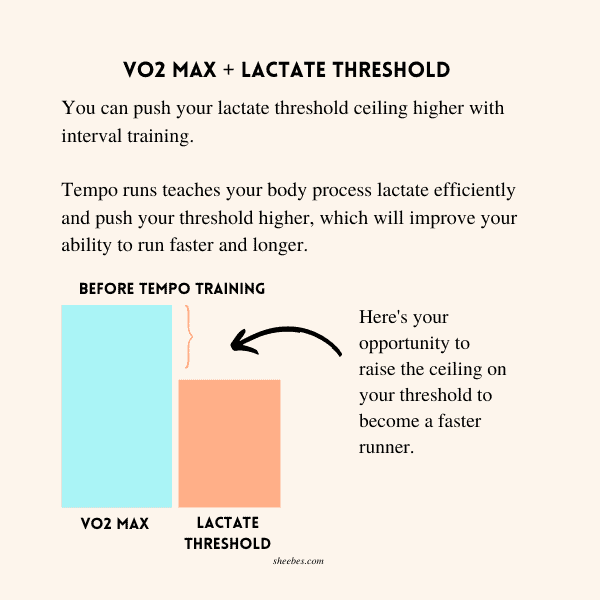
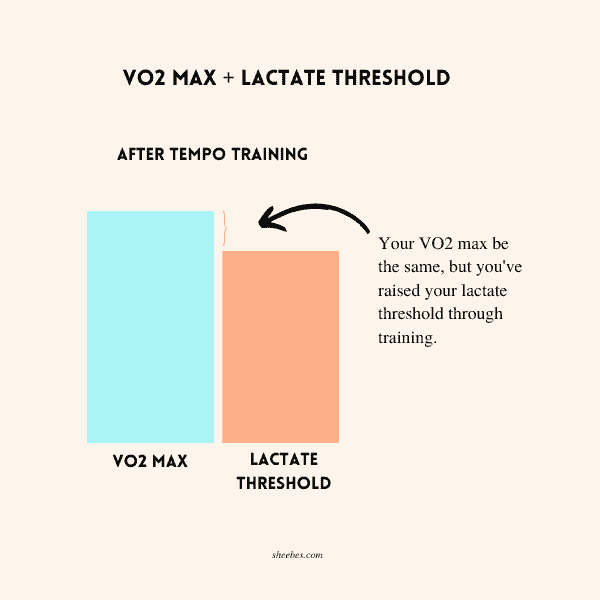
VO2 Max is the maximum amount of oxygen your body can process and use in a minute when running.
A high VO2 max means your body processes and uses oxygen more efficiently than someone with low VO2 max. A high VO2 max is typically seen as a sign of athletic ability. (I won’t dive into all the details of VO2 max here, but VO2 max values vary by gender, age, and training history.)
While a higher VO2 max number is advantageous, and you can train to push yourself to a higher number, it’s not as important as the ability to make the most of your VO2 max.
So how do we make the most of what you have right now with your current VO2 max?
Here’s where we need to talk about lactate threshold.
About lactate threshold
Your body creates and uses lactate as you move throughout the day.
Lactate forms when your body breaks down sugar for energy when there’s not enough oxygen.
As you go about your normal daily activities, your body uses all the lactate it produces throughout the day.
But it’s a different story when you’re doing speedwork—your body can’t convert lactate back into fuel as quickly as it’s made.
Eventually, there will be a spike in blood lactate, and this point is called your lactate threshold. Once you reach lactate threshold, you’ll begin to slow down.
But the good news is you can train your body to process lactate efficiently and push your threshold higher, improving your ability to run faster and longer.
The more you train your body to process lactate — through tempo running — the more quickly it will be at processing lactate.
Who should do a tempo run?
If you’re a half marathoner or a marathoner, weekly tempo runs are vital because you’re teaching yourself to run fast for miles.
So if you’re gunning for a new personal record in your half marathon or looking to qualify for Boston, tempo training runs are essential to helping you get there.
If you’re racing shorter distances like the 5K and 10K, tempo running won’t boost your running speed as much as track workouts, but that doesn’t mean you have to write them off altogether.
Doing weekly tempo training runs can help you bust through a running plateau, keep your runs interesting, and add variety to your training.
Tempo running teaches your body to run fast, and these runs also build your running mental toughness.
Building your running mental toughness can encourage you to lace up your running shoes, dig deep in the final miles of your half marathon, and boost your running motivation.
The good thing is mental toughness is a skill you can develop. And one of those ways you can build mental grit is through tempo runs because you’re training your brain to hold a comfortably hard effort while enduring discomfort.
How to do a tempo run
Tempo workouts should be part of your weekly routine. And because they’re challenging workouts, what you do the day before, the day of, and the day after a tempo run matters.
A snapshot of your running schedule might look like this:
Wednesday: Easy run day to save your running legs and energy for tomorrow
Thursday: Tempo run day
Friday: 30-minute recovery run to speed up your recovery from yesterday’s tempo run
Classic tempo workout
Warm up for 10 to 15 minutes with easy walking or running
20 minutes tempo effort*
Cool down with 10 minutes of light jogging
How to find your tempo run pace
Are you wondering, ‘what is my tempo pace?’. You can find your tempo run pace and tempo run heart rate in three ways. By:
Race pace
Your tempo run pace should fall between your 10K or half marathon pace, or at a pace you can hold for one hour.
Rate of perceived exertion (RPE)
Using RPE is a little tricky because it’s a subjective measurement of how hard you *think* you’re working.
But that’s a good thing because by feeling your pace, you’ll never run above your abilities at the moment, avoiding injury and burnout.
On a scale of 1 to 10 (max effort), your tempo run pace will be around 5-6 out of 10 on the RPE scale, and it will be difficult to speak in full sentences.
Heart rate
You can find your tempo run heart rate if you take your max heart rate and calculate 80 to 85% of your max heart rate for your tempo run pace.
Not sure what your max heart rate is? These three maximum heart rate formulas can help.
[220 – Age] – most commonly used maximum heart rate formula for men and women
[208 – ( 0.7 x Age )] maximum heart rate formula adjusted for men and women over the age of 401NOTE: This formula tends to overestimate the maximum heart rate for women, and a female-specific formula to use is 206 – (0.88 x age) 2
[211 – (0.64 x Age )] – for men and women who are active
- Age-Predicted Maximal Heart Rate in Recreational Marathon Runners: A Cross-Sectional Study on Fox’s and Tanaka’s Equations ↩
- Heart Rate Response to Exercise Stress Testing in Asymptomatic Women ↩